Gallery and Museum Lighting
Galleries use Ra 90 track and zoom spots aimed at about 30° from vertical, which lights work evenly and throws glazing reflections to the floor rather than at visitors. Conservation guidance commonly limits light-sensitive works such as paper, textiles and photographs to around 50 lx, and oil and acrylic paintings to about 150–200 lx.
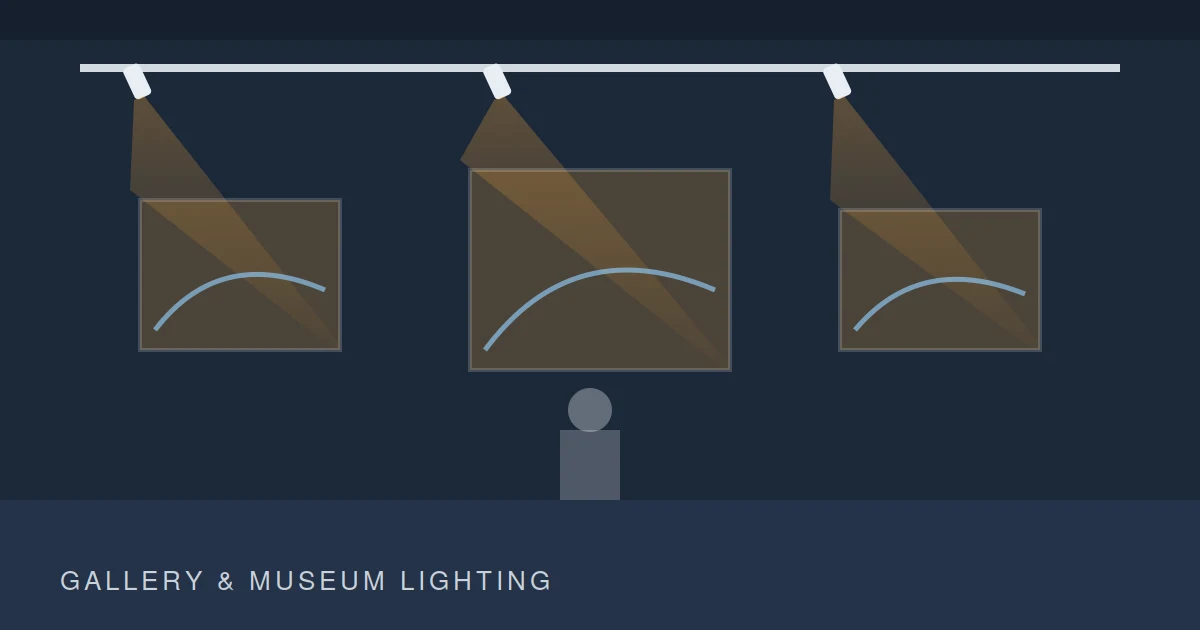
Gallery and museum lighting uses Ra 90 track spots and zoom spots on flexible track, aimed at about 30° to each work, with light levels kept within conservation limits for sensitive pieces. Track lets the lighting follow every new exhibition, zoom spots fit each work’s size, and high colour rendering shows paint and materials as the artist intended. KELVANO supplies the track spots, zoom spots and grid downlights for galleries, museums and art retail.
What a gallery needs
| Need | Why | What we supply |
|---|---|---|
| True colour | Paintings and objects must look as intended | Ra 90 series on our track pages |
| Flexibility | Every exhibition hangs differently | LED track lighting on 3-circuit track |
| Beam to fit each work | Small works and large canvases need different beams | Zoomable track spotlight, 15° to 60° |
| Conservation | Sensitive works need low, controlled light | Dimmable drivers: Triac, 0-10V, DALI, Bluetooth |
| No glare or reflections | Visitors look at glazed and varnished works | Correct aiming angle, deep optics |
Conservation light levels
Light causes fading over time. Your conservator sets limits for each piece, but common guidance is:
| Sensitivity | Typical examples | Common guidance |
|---|---|---|
| High | Works on paper, textiles, photographs, watercolours | About 50 lx |
| Moderate | Oil and acrylic paintings, wood, lacquer | About 150 to 200 lx |
| Low | Stone, metal, ceramics, glass | Set by display needs |
White LEDs give off very little ultraviolet or infrared, the main causes of fading and heat damage from older sources. Dimmable drivers let you hold each work at its limit; see the LED dimming guide.
Aiming and beam angle
- Aim at about 30° from vertical. This lights the work evenly and throws reflections from glazing down to the floor rather than into visitors’ eyes.
- Match the beam to the work. Narrow 15° beams for small works; 36° or more, or two spots, for large canvases.
- Use a zoom spot where works change often. The zoomable track spotlight adjusts from 15° to 60° on the head, so one fitting fits the next hang.
See the beam angle guide for spot sizes by distance.
Colour temperature
Around 3000K is common for paintings and historic objects, giving a warm, natural feel. Contemporary galleries often use around 4000K for a neutral, white-wall look. Most of our spot series can be supplied with a switch that selects one of three colour temperatures on site, so each room can be set to its exhibition. Exact settings are confirmed per model on your quotation.
Beyond the walls
- Sculpture and objects: two or three spots from different angles show form and texture.
- Circulation and entrances: anti-glare downlights for an even, calm base light.
- Gallery shops and art retail: see retail store lighting.
Plan your gallery
Send your floor plan, ceiling height and the types of works you show. We return a spot selection, with a quotation within 24 hours. We can prepare a lighting layout for qualified projects. Orders run from 50 units to full projects.
Request a quote → · WhatsApp +86 189 9834 8092 · info@kelvano.co · replies within business hours (GMT+8)
Questions from specifiers
What lighting is best for an art gallery?
How much light can artworks take?
Is LED safe for artworks?
What beam angle suits a painting?
Where should the track be positioned?
Send your floor plan.
Get a lux layout back.
- Quotation within 24 hours, FOB, or DDP for the UK and EU, pricing by quantity
- Samples are charged at USD 100–300 per piece, depending on the product and its configuration. Standard samples are ready in 7 days; samples that need new tooling are quoted with their own lead time. The sample charge is credited against your first order over USD 3,000 placed within six months.
- Orders of around 500 units ship in 25–35 days from the deposit; larger or customised orders are confirmed on the proforma invoice.
- IES and LDT photometric files can be measured for project specifications
- Answered by our project team